<a href='/tag/trunnion-mounted-ball' target='_blank' class='key-tag'><font><strong>trunnion Mounted Ball</strong></font></a> Valve Design Explained: Complete Technical Guide
Trunnion Mounted Ball Valve Design Explained: Complete Guide
Trunnion mounted ball valves are critical flow control components in high‑pressure
pipelines, oil and gas systems, petrochemical plants, power generation facilities,
and many other industrial applications. This in‑depth technical guide explains the
design, working principle, components, standards, advantages, limitations, sizing,
and selection of trunnion mounted ball valves in clear and SEO‑friendly English.
1. What Is a Trunnion Mounted Ball Valve?
A trunnion mounted ball valve is a quarter‑turn valve in which the ball is
mechanically supported by trunnions (fixed shafts or journals) at the top and
bottom. The trunnions hold the ball in a fixed position, while line pressure
pushes the floating seats against the ball to achieve tight shut‑off.
Unlike a floating ball valve where the ball moves slightly downstream to seal,
the trunnion mounted ball valve keeps the ball restrained and allows the seats
to move. This structural difference enables trunnion mounted ball valves to
handle larger sizes, higher pressures, and more demanding service conditions
with reduced operating torque.
1.1 Key Characteristics
- Quarter‑turn rotary motion (0°–90°) between fully open and fully closed.
- Ball is supported by trunnions (top and bottom shafts or pins).
- Seats are spring‑loaded or pressure‑energized and can be self‑relieving.
- Designed for high pressure, large diameter, and critical isolation service.
- Suitable for both onshore and offshore oil and gas pipeline systems.
- Available in soft‑seated and metal‑seated designs for various media.
1.2 Typical Applications
Common applications for trunnion mounted ball valves include:
- Oil and gas transmission pipelines (liquid and gas service).
- Gas processing plants and compressor stations.
- Refineries and petrochemical complexes.
- Offshore platforms and subsea pipeline systems.
- High‑pressure water injection systems.
- Power generation plants, including combined‑cycle and cogeneration.
- LNG facilities and cryogenic service (special cryogenic design required).
- Storage terminals, tank farms, and loading/unloading manifolds.
Typical Uses of Trunnion Mounted Ball Valves by Industry
Industry |
Typical Media |
Typical Pressure Class |
Valve Size Range |
Oil & Gas Transmission |
Crude oil, natural gas, refined products |
ASME 300 – 2500 |
DN 50 – DN 1400 (2" – 56") |
Petrochemical & Refining |
Hydrocarbons, solvents, process fluids |
ASME 150 – 1500 |
DN 25 – DN 600 (1" – 24") |
Power Generation |
Feedwater, steam (special design), cooling water |
ASME 300 – 2500 |
DN 50 – DN 900 (2" – 36") |
Chemical & Industrial |
Corrosive liquids, gases, slurries |
ASME 150 – 600 |
DN 25 – DN 400 (1" – 16") |
LNG & Cryogenic |
Liquefied natural gas, cryogenic hydrocarbons |
ASME 150 – 900 |
DN 50 – DN 600 (2" – 24") |
2. Trunnion Mounted Ball Valve Design Principle
The design principle of a trunnion mounted ball valve is based on a fixed ball
with floating, pressure‑energized seats. The trunnion shaft at the bottom and
the stem at the top hold the ball in position. When differential pressure is
present, the seats move towards the ball to create a tight seal.
2.1 How a Trunnion Ball Valve Works
The basic working principle involves the following steps:
-
In the open position, the bore of the ball is aligned with the
pipeline, allowing full flow with minimal pressure drop. The seats are
slightly retracted by springs or balanced by pressure.
-
When the valve starts closing, the actuator or handle rotates the
stem and ball 90 degrees. Flow is gradually throttled as the bore moves
out of alignment with the pipeline.
-
In the closed position, the solid part of the ball blocks the flow
path. Line pressure acts on the upstream seat, pushing it firmly against
the ball. The downstream seat may also be energized depending on design
(single piston effect or double piston effect seats).
-
Trunnions support the ball and absorb line pressure loads, while
seats are free to float axially to maintain sealing under varying
pressure conditions.
2.2 Force Balance and Torque
In trunnion mounted ball valves, the ball is not pushed downstream by line
pressure. Instead, forces are transmitted to the trunnions. This changes the
torque profile compared to floating ball valves:
- Lower and more predictable operating torque.
- Improved suitability for gearboxes and automatic actuators.
- Reduced seat wear due to controlled contact pressure.
Seat design (spring force, sealing lip geometry, and contact area) is optimized
to balance sealing performance with acceptable operating torque.
2.3 Single Piston Effect vs Double Piston Effect Seats
Trunnion mounted ball valve seats are often classified as:
Comparison of Single Piston Effect vs Double Piston Effect Seats
Feature |
SPE Seats |
DPE Seats |
Sealing Direction |
Usually uni‑directional or bi‑directional with self‑relief |
Bi‑directional sealing |
Cavity Pressure Relief |
Automatic self‑relieving through seat |
Requires external relief device |
Leakage Safety |
One seat may unseal to relieve pressure |
Both seats keep sealing pressure |
Typical Use |
Standard pipeline and process valves |
Critical isolation, double block and bleed |
3. Main Components of a Trunnion Mounted Ball Valve
The design of a trunnion mounted ball valve consists of several key parts
that work together to provide reliable isolation. Understanding each
component helps engineers select and specify the correct valve configuration.
3.1 Valve Body
The body is the pressure‑containing shell of the trunnion mounted ball valve.
It connects to the pipeline and houses the ball, seats, and internal
components. Trunnion ball valves are commonly manufactured in the following
body constructions:
- Two‑piece split body – body and one end closure.
- Three‑piece body – separate center section and two end closures.
- Fully welded body – welded construction for buried or subsea service.
- Side entry – ball inserted from the side of the body.
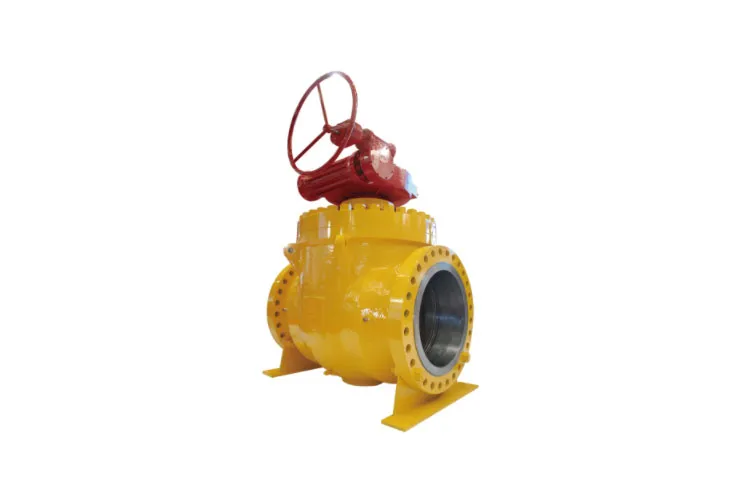
- Top entry – ball and trim inserted from the top for in‑line maintenance.
3.2 Ball
The ball is the rotating closure member with a through‑bore. In trunnion
design, the ball is held rigidly by trunnion and stem. Key ball design
aspects:
- Full bore ball – bore diameter equal to nominal pipe size.
- Reduced bore ball – smaller bore to reduce weight and cost.
- Segmented or V‑port ball – for control and throttling (less common in trunnion valves).
- Surface hardening, overlay, or coating for metal seated valves.
3.3 Trunnion
The trunnion is the fixed shaft, pin, or journal that supports the ball at the
bottom (and sometimes top) of the valve. It absorbs pressure‑induced
loads and transfers them to the body, reducing the load on the seats and
stem. Trunnions usually run in bushings or bearings to minimize friction.
3.4 Seats
Trunnion mounted ball valves use independent floating seats to seal against the ball.
Seats can be:
- Soft‑seated – with PTFE, RTFE, nylon, or other polymer inserts.
- Metal‑seated – with metal‑to‑metal sealing for high temperature, erosive, or severe service.
- Combination seats – metal backup with soft inserts.
Seats are usually spring‑loaded to maintain initial contact with the ball and
to ensure sealing at low differential pressure. Pressure acts on the back
side of the seat to enhance sealing (pressure‑energized seat).
3.5 Stem
The stem connects the ball to the operating device (lever, gearbox, actuator).
In many trunnion designs, the stem is separate from the lower trunnion, but
some designs use integral stems and trunnions. Typical stem features:
- A blow‑out proof design, inserted from inside the body.
- Multiple stem seals and packings (O‑rings, graphite packing rings).
- Standardized top‑mounting flange per ISO 5211 for actuation.
3.6 Seals and Gaskets
To ensure zero external leakage, trunnion mounted ball valves use:
- Body gaskets (spiral wound, ring joint, or O‑ring type).
- Stem seals (O‑rings, lip seals, graphite packing for high temperature).
- Seat O‑rings or lip seals between seat and body.
3.7 Bearings and Bushings
Bearings or bushings support the stem and trunnion, reducing friction and
torque. Materials include PTFE‑filled bearings, bronze, or stainless steel with
low‑friction liners depending on service and load.
3.8 Anti‑Static and Fire‑Safe Features
To meet industry safety requirements, trunnion mounted ball valves are often
designed with:
- Anti‑static devices ensuring electrical continuity between ball, stem, and body.
- Fire‑safe design with metal‑to‑metal backup sealing when soft parts are destroyed by fire.
4. Materials Used in Trunnion Mounted Ball Valve Design
Material selection for trunnion mounted ball valves is critical for safety,
reliability, and longevity. Materials must meet pressure‑temperature ratings,
corrosion resistance, and design standards.
4.1 Common Body Materials
Typical Body Materials for Trunnion Mounted Ball Valves
Material |
Standard Designation |
Typical Application |
Carbon Steel |
ASTM A216 WCB, ASTM A105 |
General purpose, oil & gas, pipelines |
Low Temperature Carbon Steel |
ASTM A352 LCB/LCC |
Low temperature service (down to −46 °C) |
Stainless Steel |
ASTM A351 CF8M, ASTM A182 F316 |
Corrosive media, chemical service |
Duplex Stainless Steel |
ASTM A995 Gr. 4A/5A |
High chloride, offshore, sour service |
Alloy Steel |
ASTM A217 WC6/WC9 |
High temperature, power plants |
Special Alloys |
Nickel alloys, superaustenitic alloys |
Highly corrosive and severe environments |
4.2 Ball and Seat Materials
Common ball and seat materials include:
- Ball:
- Stainless steel (AISI 316, 410, 420).
- Overlayed or coated with hard materials (Stellite, tungsten carbide, chromium carbide).
- Electroless nickel plating or chromium plating for corrosion and wear resistance.
- Seat Inserts:
- PTFE, RPTFE, PEEK, nylon for soft‑seated valves.
- Stellite, tungsten carbide, hardened stainless steel for metal‑seated valves.
4.3 Stem, Trunnion, and Trim Materials
The stem and trunnion are often made from high‑strength stainless steels or
alloy steels. Corrosion resistance, strength, and galling resistance are key
criteria. Trim components (glands, fasteners, bushings) are typically selected
to be compatible with body and operating conditions.
5. Design Codes, Standards, and Certifications
Trunnion mounted ball valves are designed and manufactured according to
international standards to ensure interoperability, safety, and performance.
5.1 Key Ball Valve Standards
Common Standards for Trunnion Mounted Ball Valves
Standard |
Title / Scope |
Relevance |
API 6D |
Specification for Pipeline Valves |
Design, testing, and marking for trunnion pipeline ball valves |
API 608 |
Metal Ball Valves Flanged, Threaded, and Welding Ends |
Smaller size industrial ball valves |
ASME B16.34 |
Valves – Flanged, Threaded, and Welding End |
Pressure‑temperature ratings and materials |
ASME B16.5 / B16.47 |
Pipe Flanges and Flanged Fittings |
Flange dimensions and ratings |
ISO 14313 |
Petroleum and Natural Gas Industries – Pipeline Transportation Systems – Pipeline Valves |
International equivalent of API 6D |
ISO 17292 |
Metal Ball Valves for Petroleum, Petrochemical, and Allied Industries |
Design and testing of ball valves |
API 607 / ISO 10497 |
Fire Test for Soft‑Seated Quarter‑Turn Valves |
Fire‑safe design verification |
API 598 / ISO 5208 |
Valve Inspection and Testing |
Pressure tests and leakage rates |
5.2 Pressure Class Ratings
Pressure‑temperature ratings for trunnion mounted ball valves are taken from
ASME B16.34. Common flange ratings:
- Class 150, 300, 600.
- Class 900, 1500, 2500 for high pressure service.
6. Advantages of Trunnion Mounted Ball Valves
Trunnion mounted ball valves offer multiple advantages over floating ball
valves and other valve types in demanding applications.
6.1 Mechanical and Operational Advantages
- Lower Operating Torque:
- Trunnion support reduces the force transmitted to the seats.
- Smaller actuators and gearboxes can be used.
- Easier manual operation for large‑diameter valves.
- Suitable for Large Sizes:
- Stable design for DN 50 to DN 2000 (2" to 80") or larger.
- Widely used for pipeline isolation valves.
- High Pressure Capability:
- Robust design for high pressure classes (up to ASME 2500 or higher in special cases).
- Reliable sealing even at extreme differential pressures.
- Reduced Seat Wear:
- Ball is fixed; seats float and adjust to pressure.
- Less friction and lower risk of seat damage during operation.
6.2 Functional and Safety Advantages
- Double Block and Bleed Capability:
- Trunnion valves can be configured for double block and bleed (DBB) or double isolation and bleed (DIB).
- Allows verification of tight shut‑off and safe maintenance.
- Reliable Bi‑Directional Sealing:
- Especially with double piston effect seat design.
- Handles pressure reversal conditions in pipelines.
- Fire‑Safe Features:
- Metal‑to‑metal backup seating when soft seats are damaged by fire.
- Compliance with API 607 or ISO 10497.
- Stem Integrity:
- Blow‑out proof stem design prevents stem ejection under pressure.
- Multi‑seal stem packing for zero external leakage.
6.3 Process and Economic Advantages
- Low Pressure Drop:
- Full bore design offers near‑zero pressure loss.
- Suitable as piggable valves in pipeline systems.
- Versatility in Service Conditions:
- Soft‑seated for clean fluids and low to medium temperatures.
- Metal‑seated for high temperature, abrasive, or dirty service.
- Long Service Life:
- Optimized load distribution increases life of ball, seats, and stem.
- Reduced maintenance frequency in remote or difficult locations.
7. Limitations and Considerations
Although trunnion mounted ball valves have many advantages, they are not
suitable for every application. Important limitations and design
considerations include:
- Higher Initial Cost:
- More complex design and machining compared to floating ball valves.
- Higher capital expenditure, especially for small sizes.
- Weight and Space:
- Heavier body with trunnion structure and bearings.
- May require more support and space in piping layouts.
- Not Ideal for Severe Throttling:
- Primarily designed for on/off isolation service.
- Throttling can cause erosion, vibration, and noise.
- Complex Internal Components:
- More parts (seats, springs, bearings) compared to simple valve types.
- Requires skilled maintenance and correct assembly.
8. Trunnion Mounted Ball Valve vs Floating Ball Valve
The choice between a trunnion mounted ball valve and a floating ball valve
depends on size, pressure, operating conditions, and cost. Both designs are
widely used, but they perform differently.
Comparison: Trunnion Mounted Ball Valve vs Floating Ball Valve
Parameter |
Trunnion Mounted Ball Valve |
Floating Ball Valve |
Ball Support |
Ball supported by trunnions (top/bottom) |
Ball supported by seats (no trunnions) |
Seat Movement |
Seats float axially to seal |
Ball moves to compress downstream seat |
Typical Size Range |
Medium to very large (2" – 60"+) |
Small to medium (½" – 12") |
Pressure Capability |
Excellent for high pressure |
Limited for larger sizes at high pressure |
Operating Torque |
Lower torque, more predictable |
Higher torque at high pressure |
Cost for Small Sizes |
Usually higher |
Generally lower |
Double Block and Bleed |
Easy to achieve (DPE seats) |
More limited and design‑dependent |
Maintenance |
More complex internals |
Simpler construction |
Typical Use |
Pipelines, high‑pressure transmission, large diameter |
Plant piping, lower pressure, smaller lines |
9. Full Bore vs Reduced Bore Trunnion Mounted Ball Valves
Bore type significantly affects flow characteristics, pressure drop, and
suitability for pigging operations.
9.1 Full Bore Trunnion Ball Valves
- Bore diameter equals pipeline inner diameter.
- Minimal pressure drop and turbulence.
- Allows passage of pipeline pigs for cleaning and inspection.
- Preferred in long‑distance pipelines and critical service.
9.2 Reduced Bore Trunnion Ball Valves
- Bore diameter smaller than pipeline ID.
- Higher pressure drop compared to full bore.
- More economical due to smaller ball and body.
- Used where pigging is not required and pressure loss is acceptable.
Full Bore vs Reduced Bore Trunnion Mounted Ball Valves
Feature |
Full Bore |
Reduced Bore |
Bore Size |
Equal to nominal pipe size |
Smaller than nominal pipe size |
Pressure Drop |
Very low |
Moderate |
Pigging Capability |
Yes |
No (generally) |
Valve Weight & Cost |
Higher |
Lower |
Typical Application |
Pipelines, critical isolation |
Process lines where pigging is not needed |
10. End Connections and Body Styles
The end connection and body style of a trunnion mounted ball valve influence
installation, maintenance, and performance characteristics.
10.1 Common End Connections
- Flanged Ends (ASME B16.5, B16.47):
- Ease of installation and removal.
- Common in above‑ground plants and easily accessible lines.
- Butt‑Weld Ends (ASME B16.25):
- Permanent, high‑integrity joints.
- Used in high pressure pipelines and buried service.
- Hub Ends / Clamp Connectors:
- Compact connections for offshore and high‑pressure systems.
10.2 Body Styles
- Side Entry:
- Two‑piece or three‑piece body with ball inserted from the side.
- Common for large diameter pipeline valves.
- Top Entry:
- Ball and internal trim accessed from top cover.
- Allows in‑line maintenance without removing the body from the pipeline.
- Fully Welded Body:
- Shell welds permanently seal the body.
- Ideal for buried pipelines and long‑term service with minimal maintenance.
11. Seat Types, Sealing, and Fire‑Safe Design
Seat design is fundamental to the reliability of trunnion mounted ball
valves. Engineers must select appropriate seat types based on temperature,
pressure, fluid corrosivity, and shut‑off requirements.
11.1 Soft‑Seated Trunnion Ball Valves
- Use thermoplastic inserts such as PTFE, RPTFE, PEEK, nylon, or Devlon.
- Offer tight shut‑off (often zero leakage) in clean services.
- Limited by temperature range of the seat material.
- Not preferred in erosive or severe particle‑laden flows.
11.2 Metal‑Seated Trunnion Ball Valves
- Metal‑to‑metal contact between hardened ball and seats.
- Withstand high temperatures, thermal cycling, and erosive fluids.
- Can be designed for high differential pressure and severe service.
- Typically higher leakage class than soft‑seated, but can still achieve tight shut‑off depending on specification.
11.3 Fire‑Safe Considerations
Fire‑safe trunnion mounted ball valves comply with standards such as API 607
or ISO 10497. In a fire scenario:
- Soft seals may be destroyed by high temperature.
- Backup metal‑to‑metal seating surfaces provide secondary sealing.
- Stem and body seals also have metal backup or graphite packing to limit external leakage.
12. Double Block and Bleed (DBB) and Double Isolation and Bleed (DIB)
One of the most important features of trunnion mounted ball valves is the
ability to provide double block and bleed or double isolation and bleed
functionality, depending on seat configuration.
12.1 Double Block and Bleed (DBB)
A DBB valve can seal against pressure from both ends of the valve with a
means of bleeding or venting the cavity between the seats. For trunnion ball
valves:
- Often implemented using SPE seats on both sides.
- The cavity can self‑relieve in case of over‑pressure.
- Bleed valve on body allows verification of seat tightness.
12.2 Double Isolation and Bleed (DIB)
DIB valves provide isolation from both sides of the valve, with both seats
sealing in both directions, and a bleed port for the cavity:
- Generally achieved using DPE seat design.
- No automatic self‑relief; requires separate cavity pressure relief device.
- Provides higher integrity isolation compared to typical DBB.
13. Actuation of Trunnion Mounted Ball Valves
Because trunnion mounted ball valves are frequently used in automated
pipeline and process systems, actuation is a critical aspect of design.
13.1 Manual Operation
- Lever for small‑size, low‑torque valves.
- Gear operator (worm gearbox) for larger sizes and higher torque.
13.2 Automatic Actuation
- Pneumatic Actuators – commonly used for fast operation and remote control.
- Hydraulic Actuators – preferred in subsea or high‑torque requirements.
- Electric Actuators – suitable where compressed air is not available.
13.3 Mounting Interface
Most trunnion mounted ball valves are supplied with ISO 5211 top flanges, which
standardize the mounting dimensions for actuators and gear operators. This
simplifies selection and interchangeability of actuation systems.
14. How to Select a Trunnion Mounted Ball Valve
Selecting the correct trunnion mounted ball valve requires evaluating process
parameters, mechanical constraints, and industry standards. Important
selection criteria include:
14.1 Process Conditions
- Fluid type: gas, liquid, slurry, corrosive, toxic, or flammable.
- Operating pressure and maximum differential pressure.
- Minimum and maximum operating temperature.
- Flow rate and required Cv (flow coefficient).
- Cleanliness of the medium (presence of particles, sand, or debris).
14.2 Valve Design Parameters
- Nominal size (DN or NPS) to match pipeline.
- Pressure class (ASME 150–2500 or equivalent).
- Bore type: full bore or reduced bore.
- Seat type: soft or metal seat.
- End connection: flanged, butt‑weld, or hub ends.
- Body type: two‑piece, three‑piece, top entry, or fully welded.
- Required sealing: uni‑directional or bi‑directional.
14.3 Compliance and Safety Requirements
- Design and testing per API 6D, ISO 14313, or ISO 17292.
- Fire‑safe compliance to API 607 or ISO 10497.
- Leakage class and seat test requirements per API 598 or ISO 5208.
- Fugitive emission performance if required.
- Antistatic and blow‑out proof stem design.
14.4 Actuation and Control
- Manual, pneumatic, hydraulic, or electric actuation.
- Fail‑safe position: fail‑open, fail‑closed, or fail‑in‑place.
- Operating speed and cycle frequency.
- Control system interface (on/off or modulating control).
15. Typical Specification Table for Trunnion Mounted Ball Valves
The following table provides an example of general specification ranges for
trunnion mounted ball valves used in industrial and pipeline applications.
Exact values depend on design, size, and manufacturer.
General Specifications of Trunnion Mounted Ball Valves
Parameter |
Typical Range / Options |
Size Range |
DN 50 – DN 1400 (2" – 56") or larger |
Pressure Class |
ASME 150 – 2500 (and API 2000/3000/5000 for certain designs) |
Body Materials |
Carbon steel, low temperature carbon steel, stainless steel, duplex, alloy steel |
Seat Type |
Soft‑seated (PTFE, RPTFE, PEEK, nylon), metal‑seated (hard‑faced) |
End Connections |
Flanged (RF/RJ), butt‑weld, hub type |
Bore Type |
Full bore, reduced bore |
Body Construction |
Two‑piece, three‑piece, top entry, fully welded |
Temperature Range |
Approx. −196 °C (cryogenic design) to >+400 °C (metal‑seated), depending on materials |
Design Standards |
API 6D, ISO 14313, ISO 17292, ASME B16.34 |
Testing Standards |
API 598, ISO 5208, API 6D test requirements |
Fire‑Safe Standards |
API 607, ISO 10497 (where applicable) |
Actuation Options |
Lever, gearbox, pneumatic, hydraulic, electric actuators |
16. Installation and Maintenance Considerations
Proper installation and maintenance practices are essential for achieving
the expected performance and service life of trunnion mounted ball valves.
16.1 Installation Guidelines
- Confirm pressure rating, size, end connection, and flow direction (if any) before installation.
- Ensure pipeline is clean and free of debris prior to valve installation.
- Align flanges or weld ends carefully to avoid stresses on the valve body.
- Support heavy trunnion valves adequately to prevent pipeline loading.
- Install valve in orientation recommended by design (horizontal or vertical as allowed).
16.2 Operation and Maintenance
- Operate valve fully open or fully closed where possible (avoid throttling unless designed for control).
- Cycle valves periodically in low‑usage applications to prevent sticking.
- Check for external leakage around body and stem; adjust packing if necessary.
- For top entry designs, internal components can be inspected and serviced in‑line.
- Follow all pressure relief and isolation procedures before maintenance.
17. Typical Application Scenarios
The superior sealing performance, high‑pressure capability, and large size
range make trunnion mounted ball valves suitable for numerous critical
applications.
17.1 Oil and Gas Transmission Pipelines
- Mainline isolation valves in cross‑country pipelines.
- Block valves at stations, river crossings, and critical sections.
- Valve stations designed for pig launching and receiving.
17.2 Refining and Petrochemical Plants
- Feed and product lines requiring tight shut‑off.
- High‑pressure reactor inlet and outlet services.
- Critical isolation in process units and manifolds.
17.3 Offshore and Subsea
- Subsea isolation valves for wellheads and manifolds (special subsea designs).
- Topside process and export lines where weight and reliability are important.
17.4 Power Generation and Industrial Plants
- High‑pressure water, gas, and feed systems.
- Fuel gas isolation and emergency shutdown valves.
18. Frequently Asked Questions about Trunnion Mounted Ball Valves
18.1 What is the main difference between trunnion and floating ball valves?
The main difference lies in how the ball is supported and how sealing is
achieved. In trunnion mounted ball valves, the ball is fixed by trunnions, and
the seats move to create a seal. In floating ball valves, the ball moves
slightly downstream to press against the seat to achieve sealing. This
difference strongly influences torque, size range, and pressure capability.
18.2 When should a trunnion mounted ball valve be used?
Use a trunnion mounted ball valve when the application involves large
diameters, high pressures, or when low and predictable operating torque is
important. They are also preferred when double block and bleed or double
isolation and bleed functionality and high integrity sealing are required.
18.3 Are trunnion ball valves suitable for throttling?
Standard trunnion mounted ball valves are mainly designed for on/off service.
Throttling or modulating service over long periods can cause erosion of the
ball and seats and may lead to vibration and noise. Specially designed
control ball valves with modified ball ports may be used if throttling is
required.
18.4 Can trunnion mounted ball valves be used in cryogenic service?
Yes, trunnion mounted ball valves can be designed for cryogenic service such
as LNG. These designs include extended stems, cryogenic trim materials, and
special seat designs suitable for very low temperatures. Standards such as
BS 6364 or industry‑specific cryogenic test procedures may apply.
18.5 What is meant by "fire‑safe" trunnion ball valve?
A fire‑safe trunnion ball valve is designed and tested to maintain a certain
level of sealing capability during and after exposure to a fire. When soft
seals are destroyed by heat, metal‑to‑metal backup seats and stem seals limit
internal and external leakage. Testing is done in accordance with standards
like API 607 or ISO 10497.
Trunnion mounted ball valves are essential components in modern industrial
and pipeline systems. Their robust design, high pressure and large size
capability, low operating torque, and ability to provide double block and
bleed isolation make them a preferred solution for critical applications in
oil and gas, petrochemical, power generation, and many other sectors.
Understanding the design principles, components, materials, standards,
seating options, and selection criteria of trunnion mounted ball valves
enables engineers, specifiers, and plant operators to choose the most
suitable valve configuration for their specific service conditions. Properly
selected, installed, and maintained trunnion mounted ball valves deliver
long‑term, safe, and efficient control of industrial fluids in some of the
most demanding environments.
“`






 Phone