Fixed Ball Valve Structure and Main Components: Complete Technical Guide
Fixed Ball Valve Structure and Main Components: Complete Technical Guide
A fixed ball valve, also known as a
trunnion mounted ball valve, is a key piece of equipment in modern
fluid control systems. This guide explains the structure,
main components, typical materials, and
design features of fixed ball valves for engineers, buyers, and
maintenance specialists.
1. What Is a Fixed Ball Valve?
A fixed ball valve is a quarter-turn shut-off valve in which the
ball is supported by trunnions (upper and lower journals).
Unlike a Floating ball valve where the ball moves slightly downstream under
pressure, the ball in a fixed ball valve is mechanically held in place
and does not translate with line pressure. The sealing load is taken mainly by
the spring-loaded or pressure-energized seats, not by the ball
shifting against the seats.
This design allows fixed ball valves to handle higher pressures,
larger sizes, and more demanding service conditions
than standard floating ball valves. Fixed ball valves are widely used in:
- Oil and gas transmission and distribution pipelines
- Petrochemical and chemical processing plants
- Refining, LNG, and gas processing facilities
- HVAC and district heating systems (for large diameters)
- Power generation and industrial utility services
In many standards and technical documents, the term
trunnion ball valve is used interchangeably with
fixed ball valve.
2. Key Features of a Fixed Ball Valve
The fixed ball valve structure introduces several features that
distinguish it from other ball valve types:
- Trunnion-mounted ball eliminates axial movement of the ball.
- Seats are movable and often spring-loaded to ensure tight sealing.
- Lower operating torque compared with floating ball valves in the same size and pressure class.
- Suitable for large nominal diameters and high-pressure ratings.
- Can be designed for double block and bleed (DBB) and double isolation and bleed (DIB) functions.
- Available in full bore and reduced bore configurations.
3. Fixed Ball Valve Structure Overview
The structure of a fixed ball valve is built around a rigidly
supported ball and movable seats. A simplified description of the internal
layout is:
- Central ball with upper and lower trunnions.
- Seat rings on both upstream and downstream sides of the ball.
- Body forming the pressure boundary and containing the ball and seats.
- Bonnet or body covers for assembly, sealing, and maintenance access.
- Stem connected to the ball to transmit actuation torque.
- Sealing elements (soft or metal seats, body gaskets, stem packing).
- Trunnion bearings or bushings supporting the ball and stem.
- Actuator interface (manual lever, gear operator, or power actuator).
Because the ball is fixed, the process pressure pushes the seats
toward the ball instead of moving the ball toward the seats. This reduces seat wear
and increases seal reliability in heavy-duty applications.
4. Main Components of a Fixed Ball Valve
A typical fixed ball valve assembly contains the following main
components:
Component |
Function in Fixed Ball Valve Structure |
Typical Materials |
Valve Body |
Primary pressure-containing shell; houses ball, seats, and internal parts. |
Carbon steel, stainless steel, alloy steel, duplex stainless. |
Ball |
Rotating closure member with flow port; controls flow by 90° rotation. |
Stainless steel, alloy steel with hard coating (e.g., ENP, HVOF). |
Trunnions |
Upper and lower supports that hold the ball in fixed axial position. |
Integral with ball or separate stainless/alloy steel pieces. |
Seats (Seat Rings) |
Provide sealing between ball and body on upstream and downstream sides. |
Metal body with soft insert (PTFE, RPTFE, PEEK) or all-metal. |
Stem (Shaft) |
Connects ball to actuator or handle; transmits torque. |
Stainless steel, alloy steel. |
Body Bonnet / End Closures |
Allow access for assembly and maintenance; sealed to body with gaskets. |
Same as body material, forged or cast. |
Seals and Gaskets |
Ensure tightness at body joints, stem, and seat interfaces. |
Graphite, PTFE, elastomers, metal gaskets. |
Stem Packing |
Prevents leakage along the stem to atmosphere. |
Graphite rings, PTFE rings, combined packing sets. |
Bearings and Bushings |
Support stem and trunnions; reduce friction and operating torque. |
PTFE, reinforced PTFE, metal-backed bearings, composite materials. |
Spring Mechanism |
Pre-loads seats against ball; maintains contact at low pressure. |
Spring steel, Inconel or other corrosion-resistant alloys. |
Actuator / Gearbox Interface |
Connects valve stem to manual or powered actuators. |
Carbon or stainless steel housings, alloy steel shafts. |
Anti-Blowout Devices |
Prevent stem ejection under pressure. |
Integral shoulder designs, retaining rings, thrust collars. |
Antistatic Devices |
Provide electrical continuity between ball, stem, and body. |
Spring-loaded metal contacts, conductive pins. |
Drain and Vent Ports |
Enable cavity relief, testing, and draining. |
Same materials as body or stainless steel inserts. |
5. Detailed Description of Fixed Ball Valve Components
5.1 Valve Body
The valve body is the pressure-retaining outer shell of the
fixed ball valve. It is designed to withstand internal pressure,
external loads, and piping forces. Body design options include:
- One-piece body (usually smaller sizes; compact but limited maintenance access).
- Two-piece body (common in medium sizes and pressures; offers balance between cost and maintenance).
- Three-piece body (widely used for trunnion ball valves; superior maintainability and modular construction).
- Top-entry body (allows access by removing bonnet without removing valve from pipeline).
Typical body materials depend on service condition:
- Carbon steel for general service and non-corrosive applications.
- Stainless steel for corrosive environments and clean services.
- Duplex or super duplex for chloride-rich and offshore conditions.
- Alloy steels for high temperature and critical applications.
5.2 Ball and Trunnions
The ball is the core closure element. In a fixed ball valve, the
ball is supported by upper and lower trunnions. Important design
points:
- Ball may be solid or hollow depending on size and weight considerations.
- Port type: full bore (same diameter as pipeline) or reduced bore.
- Surface: precision machined and often hard-coated to improve wear resistance and sealing performance.
Ball Feature |
Description |
Typical Benefit |
Trunnion Mounting |
Ball is held by journals at top and bottom. |
Reduces seat load, suitable for high pressure and large diameter. |
Hard Coating |
ENP, HVOF, chrome, tungsten carbide coatings on ball surface. |
Improved abrasion resistance, extended service life, better metal-to-metal sealing. |
Full Bore Port |
Bore diameter ~ pipeline inner diameter. |
Minimal pressure drop, piggable pipeline design. |
Reduced Bore Port |
Smaller bore than pipeline. |
Lower cost, more compact, still good shut-off. |
5.3 Seats and Sealing Rings
The seats are responsible for achieving tight shut-off
between the ball and the valve body. In a fixed ball valve, seats are usually
independent movable components that can slide slightly along
the valve axis.
Main design types:
- Soft seated fixed ball valves with PTFE, RPTFE, PEEK, or other polymers.
- Metal seated fixed ball valves with hard facing on seat and ball.
- Composite seats combining metal carrier ring with soft sealing insert.
Seat Type |
Typical Material |
Service Characteristics |
Soft Seat |
PTFE, RPTFE, PCTFE, PEEK, Nylon. |
Bubble-tight sealing, low torque; limited temperature and chemical compatibility depending on polymer. |
Metal Seat |
Stainless or alloy steel with hard coating (Stellite, tungsten carbide, chromium carbide). |
High-temperature service, erosive fluids, steam, and severe conditions; Class IV–V leakage or better. |
Composite Seat |
Metal carrier with polymer insert and spring. |
Combination of structural strength and soft sealing; suitable for many industrial applications. |
5.4 Stem Assembly
The stem connects the ball to the external actuation mechanism.
In a fixed ball valve, the stem is typically non-rising and
top-mounted. Key functions:
- Transmits torque from handle, gearbox, or actuator to the ball.
- Maintains alignment with bearings and packing.
- Incorporates anti-blowout design to prevent stem ejection.
The stem is sealed by a combination of packing rings,
O-rings, and sometimes live-loaded springs to
compensate for wear and temperature changes.
5.5 Bearings, Bushings, and Support Elements
The fixed ball valve structure relies on low-friction support
components to ensure smooth operation:
- Stem bearings to center the stem and reduce wear.
- Trunnion bearings or bushings to support ball journals.
- Materials such as reinforced PTFE, composite bearings, or metal-backed PTFE.
Proper bearing design reduces operating torque and
extends the service life of the valve.
5.6 Springs and Seat Loading Mechanisms
Most fixed ball valves use spring-loaded seats.
The springs push the seats toward the ball to:
- Maintain sealing contact at low differential pressure.
- Compensate for wear, thermal expansion, or contraction.
- Allow bidirectional sealing for double block and bleed designs.
Springs are often made from corrosion-resistant alloys and
designed based on the valve size and pressure class.
5.7 Body Gaskets and Seals
Body and bonnet joints are sealed with gaskets, which can be:
- Spiral wound gaskets with graphite or PTFE filler.
- Ring joint gaskets for high pressure classes.
- Metal-to-metal contact with soft sealing inlay.
The choice of gasket type depends on pressure, temperature, and fluid
compatibility requirements.
5.8 Drain, Vent, and Injection Fittings
Industrial fixed ball valves frequently include:
- Body cavity drain to remove trapped medium.
- Vent port for depressurizing and testing.
- Sealant injection fittings for emergency seat or stem sealing in critical applications.
These features assist in maintenance,
pressure relief, and integrity testing.
6. Internal Flow Path and Sealing Principle
The flow path in a fixed ball valve is controlled by the ball
port alignment:
- Open position: ball port aligns with pipeline, allowing flow.
- Closed position: solid portion of ball blocks the flow path.
In a trunnion-mounted design, when the valve is closed and
pressure is applied:
- Process pressure acts on the upstream seat.
- The seat, being movable, is pushed against the ball.
- Sealing contact pressure is created between seat and ball face.
Because the ball does not move axially, seat wear is reduced
compared to floating ball valves. Valve design may incorporate:
- Self-relieving seats to relieve overpressure in the cavity.
- Automatic body cavity relief to downstream side for safety.
- Bidirectional sealing seats for double block and bleed applications.
7. Common Materials for Fixed Ball Valve Components
Material selection for each fixed ball valve component depends
on process conditions such as pressure, temperature, and fluid composition.
Component |
Common Materials |
Typical Applications |
Body / Bonnet |
ASTM A105, A350 LF2, A216 WCB, CF8M, duplex stainless. |
General service, low-temperature service, corrosive service, offshore. |
Ball |
SS 316, duplex SS, Inconel overlay, ENP-coated carbon steel. |
Oil, gas, corrosive fluids, high-pressure lines. |
Seats |
PTFE, RPTFE, PEEK, metal alloy with Stellite or WC overlay. |
Clean fluids, chemical service, high-temperature, abrasive media. |
Stem |
SS 410, SS 316, 17-4PH, duplex stainless. |
High strength and corrosion resistance in rotating shaft. |
Seals / Packing |
Graphite, PTFE, elastomers (Viton, NBR, EPDM). |
Stem sealing, body sealing, low fugitive emissions. |
Springs |
Inconel X-750, 17-7PH, SS 316. |
Seat pre-load in corrosive and high-temperature environments. |
Bearings |
PTFE-based composites, metal-backed PTFE, bronze. |
Low friction support for stem and trunnions. |
8. Types of Fixed Ball Valve Body Designs
The structure of fixed ball valves can be divided into several
common body configurations:
8.1 Side-Entry (Split Body) Fixed Ball Valve
- Body made from two or three sections, assembled with bolts.
- Seats, ball, and trunnions inserted from the side during assembly.
- Most widely used design in pipeline and industrial applications.
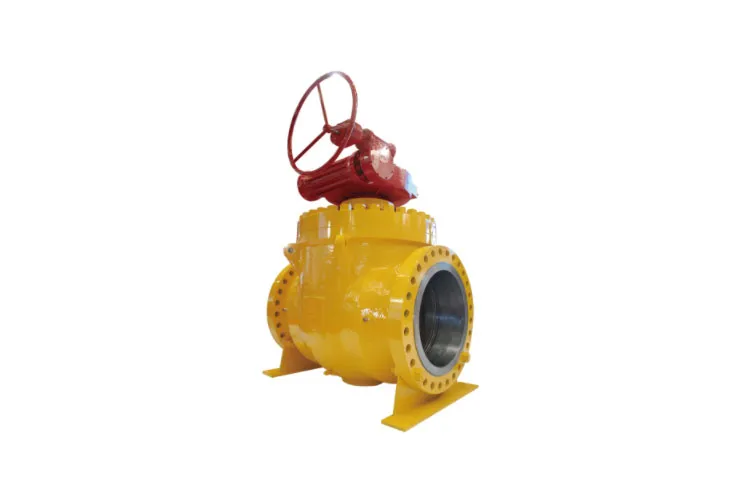
8.2 Top-Entry Fixed Ball Valve
- Body has a top cover or bonnet allowing access from above.
- Ideal where online maintenance is required without removing valve from line.
- Often used in critical and high-value service locations.
8.3 Fully Welded Fixed Ball Valve
- Body is welded instead of bolted to minimize external leakage paths.
- Common in buried pipelines and gas distribution networks.
- Offers superior integrity but limited internal access for maintenance.
9. Operation and Actuation of Fixed Ball Valves
Fixed ball valves are quarter-turn valves. They can be operated
by:
- Manual lever for small sizes and low torque.
- Manual gearbox (worm gear) for larger diameters and higher class ratings.
- Pneumatic actuators for fast and frequent operation.
- Hydraulic actuators in high-torque, subsea, or remote locations.
- Electric actuators where electrical control is preferred.
Due to the trunnion-mounted design and low friction bearings,
the operating torque is significantly lower than that of
floating ball valves in comparable sizes. This reduces:
- Actuator size and cost.
- Manual operator effort.
- Potential for mechanical damage to seats and stem.
10. Advantages of Fixed Ball Valve Structure
The fixed ball valve structure offers several advantages for
demanding industrial applications:
Advantage |
Structural Feature |
Resulting Benefit |
High Pressure Capability |
Ball supported by trunnions; seat carries pressure load. |
Suitable for high-pressure pipelines and process systems. |
Low Operating Torque |
Trunnion bearings, movable seats, optimized sealing contact. |
Smaller actuators, easy manual operation. |
Improved Seat Life |
Ball does not move axially; seats are pressure-energized. |
Reduced wear and longer sealing performance. |
Large Size Availability |
Robust body and support structure for large diameters. |
Common in pipeline sizes up to DN 1200 (NPS 48) and beyond. |
Double Block and Bleed |
Independent upstream and downstream seats, body cavity port. |
Isolation and verification for maintenance and safety. |
Bidirectional Sealing |
Symmetric seat design; spring-loaded from both sides. |
Sealing in both flow directions under pressure. |
Versatile Materials |
Wide selection of body, trim, and seat materials. |
Adaptable to corrosive, high-temperature, and abrasive services. |
11. Selection Criteria for Fixed Ball Valves
When selecting a fixed ball valve, engineers typically evaluate:
- Nominal size and bore (full bore vs. reduced bore).
- Pressure rating (ANSI / ASME Class, PN rating).
- Temperature range and corresponding material limits.
- Fluid type (clean gas, oil, slurry, corrosive chemicals, etc.).
- Seat type (soft or metal seating depending on leakage class and service).
- End connections (flanged, butt-weld, socket-weld, threaded).
- Actuation method and required accessories (limit switches, positioners, solenoids).
- Design standards and certifications applicable to the installation.
12. Typical Specification Table for Fixed Ball Valves
The following is an example of typical technical specifications
for industrial fixed ball valves. Actual values depend on detailed design and
applicable standards.
Parameter |
Typical Range / Options |
Notes for Fixed Ball Valve Structure |
Size Range |
DN 50 – DN 1200 (NPS 2″ – 48″) and above |
Fixed ball valves are ideal for medium to large sizes. |
Pressure Class |
ASME Class 150 – 2500; PN 10 – PN 420 |
Trunnion-mounted design supports high-pressure service. |
Body Materials |
Carbon steel, stainless steel, duplex, alloy steel |
Selected according to process fluid and temperature. |
Seat Materials |
PTFE, RPTFE, PEEK, metal seats with hard facing |
Determines allowable temperature and leakage performance. |
End Connections |
Flanged RF/RTJ, butt-weld, socket-weld, threaded |
Must match pipeline design and installation standards. |
Bore Type |
Full bore, reduced bore |
Full bore often used for piggable pipelines. |
Operating Temperature |
-196 °C to +450 °C, depending on materials |
Low-temperature valves require special materials and design. |
Operation |
Manual lever, gear, pneumatic, electric, hydraulic |
Chosen based on torque and control requirements. |
Sealing Class |
ISO 5208, API 598, API 6D leakage rates |
Soft-seated valves can achieve bubble-tight shut-off. |
Design Standards |
API, ASME, ISO, EN valve design codes |
Ensures safety, reliability, and dimensional compatibility. |
13. Typical Applications of Fixed Ball Valves
Because of their robust structure and reliable
main components, fixed ball valves are used in:
- Pipeline isolation in transmission systems for crude oil, natural gas, and refined products.
- Block valves in compressor stations and pumping stations.
- Process isolation in refineries and petrochemical units.
- Onshore and offshore wellhead and manifold systems.
- Tank farm inlet and outlet lines.
- Power plants and industrial utility services.
14. Maintenance Considerations for Fixed Ball Valves
The fixed ball valve structure is designed for long service
life, but periodic inspection is important:
- Check stem packing for signs of external leakage and adjust or replace if needed.
- Operate the valve periodically to ensure full movement and prevent sticking.
- Inspect body seals and gaskets during scheduled shutdowns.
- For valves with injection fittings, maintain adequate sealant according to procedures.
- Verify proper function of drain and vent ports.
Top-entry and split-body fixed ball valves allow internal components such as
seats and ball to be serviced or replaced without fully
removing the valve from the pipeline, depending on installation and design.
15. Fixed Ball Valve vs. Floating Ball Valve
Understanding the differences between fixed (trunnion) ball valves
and floating ball valves helps in choosing the appropriate type.
Feature |
Fixed (Trunnion) Ball Valve |
Floating Ball Valve |
Ball Support |
Ball is supported by trunnions at top and bottom. |
Ball is held only by seats and stem. |
Seat Loading |
Seats are movable and pushed toward fixed ball. |
Pressure pushes ball against downstream seat. |
Typical Sizes |
Medium to large sizes, e.g., NPS 2″ – 48″. |
Smaller sizes, often NPS 1/2″ – 8″. |
Operating Torque |
Generally lower due to trunnion support and bearings. |
Higher, especially at high pressure. |
Pressure Capability |
Suitable for higher pressure classes. |
More common in low to medium pressure service. |
Seat Wear |
Reduced wear; ball does not move axially. |
More wear due to ball movement against seats. |
16. Safety and Design Options in Fixed Ball Valves
Modern fixed ball valve structures incorporate several safety
features:
- Anti-blowout stem design to prevent stem ejection.
- Antistatic devices to avoid static electricity build-up between ball and stem/body.
- Fire-safe construction with metal back-up sealing in case of seat damage by fire.
- Fugitive emission control with low-emission packing systems.
- Locking devices to prevent unauthorized operation.
- Position indicators and limit switches to confirm open/closed status.
These options depend on project specifications and regulatory requirements.
A fixed ball valve, or trunnion mounted ball valve,
is a robust and versatile solution for high-pressure,
large-diameter, and critical isolation
applications. Its structure, based on a trunnion-supported ball
and movable seats, provides low operating torque, long service
life, and reliable sealing.
Understanding the main components of a fixed ball valve—body,
ball, trunnions, seats, stem, seals, bearings, and actuation interface—helps
engineers and users to make informed decisions regarding valve selection,
specification, and maintenance. By focusing on
proper material selection, structural design, and quality components, fixed ball
valves can deliver safe and efficient service across a wide range of industrial
applications.
“`





 Phone