Common Problems in <a href='/tag/trunnion-mounted-ball' target='_blank' class='key-tag'><font><strong>trunnion Mounted Ball</strong></font></a> Valves: Causes, Effects, and Solutions
Common Problems in Trunnion Mounted Ball Valves: Comprehensive Guide
Trunnion mounted ball valves are widely used in pipelines and process plants for reliable shut-off,
especially in high-pressure and large-diameter applications. However, like all mechanical equipment,
trunnion mounted ball valves can develop issues over time. Understanding the
common problems in trunnion mounted ball valves is essential for safe, efficient,
and cost-effective operation.
This guide provides detailed, industry-neutral information on definitions, design features, advantages,
specifications, typical failure modes, causes, effects, and practical troubleshooting and maintenance
strategies. It is suitable for use as a technical blog article, industry landing page, or reference
resource.
Table of Contents
what-is-trunnion-mounted-ball-valve”>What Is a Trunnion Mounted Ball Valve?
basic-construction”>Basic Construction and Main Components
working-principle”>Working Principle of Trunnion Mounted Ball Valves
advantages-and-limitations”>Advantages and Limitations
typical-specifications”>Typical Specifications and Technical Data
common-problems-overview”>Overview of Common Problems in Trunnion Mounted Ball Valves
internal-leakage-seats”>Internal Leakage Through Seats (Seat Leakage)
external-leakage-stem-body”>External Leakage at Stem, Body, and End Connections
operating-torque-issues”>High Operating Torque and Stuck Ball
seat-and-sealing-surface-damage”>Seat and Sealing Surface Damage
trunnion-and-bearing-failures”>Trunnion and Bearing Failures
cavity-pressure-and-blockage”>Body Cavity Overpressure and Blockage
actuator-and-control-problems”>Actuator and Control Problems
installation-and-commissioning-issues”>Installation and Commissioning Issues
operation-maintenance-recommendations”>Operation and Maintenance Recommendations
inspection-testing-standards”>Inspection, Testing, and Relevant Standards
materials-and-corrosion-considerations”>Materials and Corrosion Considerations
best-practices-reliability”>Best Practices for Long-Term Reliability
faq”>FAQ: Common Questions About Trunnion Mounted Ball Valve Problems
1. What Is a Trunnion Mounted Ball Valve?
A trunnion mounted ball valve is a quarter-turn valve in which the ball is supported
by trunnions (upper and lower shafts) that hold the ball firmly in position. The ball does not float
against the downstream seat as in a Floating ball
seats move towards the ball to provide sealing.
Trunnion ball valves are typically used in:
High-pressure pipelines
Large diameter lines
Oil and gas transmission and distribution
Petrochemical and refinery units
Pipelines requiring double block and bleed capability
Because of their robust construction, trunnion mounted ball valves provide reliable shut-off, low
torque, and long service life, but they also present specific
common problems and failure patterns that need to be understood and managed.
2. Basic Construction and Main Components
To understand common problems in trunnion mounted ball valves , it is important to
know the key components and how they interact.
2.1 Main Components
Component
Function
Typical Problems Related
Body
Pressure-containing shell that houses the ball, seats, and internals.
Body leakage, corrosion, erosion, cracking, casting defects.
Ball
Rotating shut-off element with a through bore for fluid flow.
Surface damage, erosion, coating failure, scoring, deformation.
Trunnion (Upper and Lower)
Supports the ball and keeps it fixed while allowing rotation.
Wear, bending, misalignment, bearing seizure.
Seats
Provide sealing between the ball and the body; may be soft or metal.
Leakage, wear, extrusion, thermal degradation, erosion.
Seat Springs
Push the seats towards the ball to ensure tight sealing.
Loss of elasticity, corrosion, fatigue, uneven loading.
Stem
Transfers torque from actuator or lever to the ball.
Stem leakage, bending, wear, breakage, galling.
Stem Seals / Packing
Prevent leakage along the stem to atmosphere.
External leakage, packing relaxation, thermal damage.
Body Gaskets / Seals
Seal body joints, end closures, and adapter flanges.
Body joint leakage, blowout, creep, chemical attack.
Bearings / Bushings
Support the trunnion and reduce friction during rotation.
High torque, jamming, wear, seizure, corrosion.
Grease Fittings / Injection Ports
Allow injection of sealing grease, lubricant, or emergency sealant.
Blockage, improper sealing, contamination.
Actuator Interface / Mounting Flange
Provides standardized connection to actuators.
Misalignment, wrong sizing, actuator failure.
2.2 Body Construction Types
Trunnion mounted ball valves are available in different body constructions. Each body style has its
own typical problems:
Body Type
Description
Typical Issues
Three-piece body
Body composed of three segments bolted together.
More gasketed joints, potential leakage paths, alignment sensitivity.
Two-piece body
Body formed by two major parts, often split body.
Body joint leakage, bolt relaxation, difficult internal access.
Fully welded body
All-welded construction, minimal external leakage paths.
No disassembly for internal inspection, demanding welding quality.
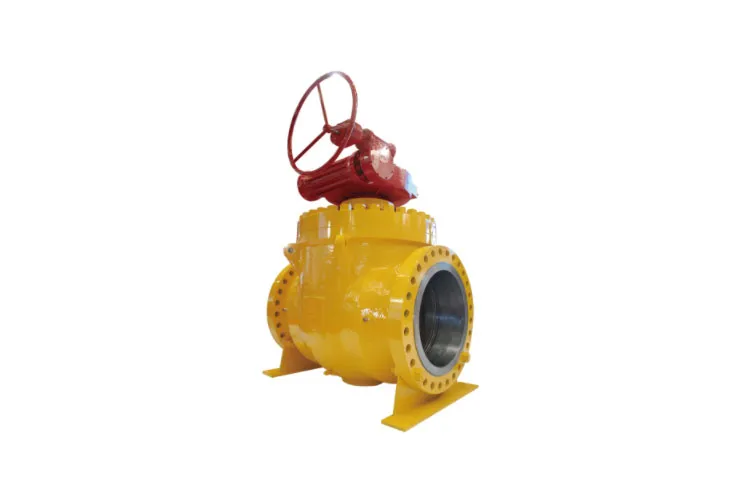
Top entry
Internals removable from the top without removing valve from line.
More complex design, stem and bonnet sealing critical.
3. Working Principle of Trunnion Mounted Ball Valves
A trunnion mounted ball valve is a quarter-turn valve. Turning the stem 90 degrees moves the ball
between open and closed positions. The trunnion design changes how sealing is achieved compared to
floating ball valves.
3.1 Basic Operation
In the open position , the ball bore is aligned with the pipeline, allowing flow
through the valve with minimal pressure drop.
In the closed position , the ball is rotated 90 degrees so that the solid side
of the ball faces the flow, blocking the passage.
Trunnions at the top and bottom hold the ball in a fixed axial position.
Seats are spring-loaded and/or pressure-energized to move against the ball to
create sealing.
3.2 Sealing Mechanism in Trunnion Ball Valves
In trunnion mounted ball valves, the line pressure acts on the downstream seat, pushing it against
the fixed ball. This allows:
Lower operating torque compared to floating ball valves.
Better performance for large sizes and high pressures.
Capability for double block and bleed design (DBB).
However, the combination of springs, seat design, and trunnion alignment introduces several
common problems such as uneven seat loading, seat sticking, excessive wear, and
inconsistent sealing.
4. Advantages and Limitations of Trunnion Mounted Ball Valves
4.1 Advantages
Low operating torque :
The trunnion support reduces the ball load on the seats, minimizing friction and torque.
Suitable for large diameter and high pressure :
The design is ideal for pipeline block valves in transmission systems.
Double block and bleed (DBB) capability :
Many trunnion mounted ball valves can isolate from both upstream and downstream sides and bleed
the cavity.
Emergency sealant injection :
Some designs include seat and stem emergency sealant injection fittings to temporarily restore
sealing in case of damage.
Fire-safe options :
Fire-safe trunnion mounted ball valves can maintain secondary metal-to-metal sealing after soft
seals are damaged by fire.
Versatile sealing materials :
Soft seat (PTFE, reinforced PTFE, elastomer) or metal seat options for severe service.
4.2 Limitations and Challenges
More complex internal design :
Additional components (trunnions, bearings, springs) introduce more potential failure points.
Sensitivity to contamination :
Debris in the pipeline can damage seats, bearings, and sealing surfaces.
Higher initial cost than some alternative valve types.
More critical installation and alignment :
Poor pipeline alignment or support can cause trunnion misalignment and sealing problems.
Potential for cavity overpressure :
If trapped fluid in the body cavity expands, overpressure can damage seals or the body.
5. Typical Specifications and Technical Data
Trunnion mounted ball valves are manufactured in a wide range of sizes, pressure classes, materials,
and end connections. The table below summarizes some typical specification ranges. Actual values
depend on standards and design.
Parameter
Typical Range / Options
Notes
Nominal Size (NPS / DN)
NPS 2" to 60" (DN 50 to DN 1500) and above
Trunnion design most common for larger sizes (≥ NPS 4").
Pressure Class
ASME Class 150 to 2500, API 2000 to 15000 psi
High-pressure pipeline and wellhead services use higher classes.
Body Materials
Carbon steel, low temperature carbon steel, stainless steel, duplex, alloy steel
Selected according to fluid, temperature, and corrosion requirements.
Ball and Trunnion Materials
Carbon steel, stainless steel, corrosion-resistant alloys, with or without hard coatings
Coatings such as ENP, tungsten carbide, chromium carbide for abrasion and corrosion resistance.
Seat Materials
Soft seats (PTFE, RTFE, PEEK, elastomers) or metal seats (hard-faced)
Soft seats for bubble-tight sealing; metal seats for high temperature or abrasive service.
End Connections
Flanged, butt-welded, socket-welded, threaded, hub type
Pipeline valves often use flanged or full-welded ends.
Operation
Manual (lever, gear), pneumatic actuator, hydraulic actuator, electric actuator
Choice depends on torque requirement, automation needs, and safety philosophy.
Design Temperature
Approximately -196 °C to +450 °C (depending on materials)
Cryogenic designs and high-temperature designs require special materials and testing.
Standards
API 6D, API 608, ISO 14313, ASME B16.34, BS, EN standards
Standard selection depends on application (pipeline vs. process).
6. Overview of Common Problems in Trunnion Mounted Ball Valves
The common problems in trunnion mounted ball valves can be grouped into several
main categories:
Internal leakage through seats (not achieving tight shut-off)
External leakage at stem, body joints, and end connections
High operating torque and sticking during opening or closing
Seat damage, erosion, extrusion, and loss of sealing capability
Trunnion, bearing, and stem failures
Body cavity overpressure and blocked relief paths
Actuator and control system issues (misalignment, sizing, calibration)
Installation, alignment, and commissioning errors
Corrosion, erosion, and material incompatibility
The following sections examine each category in detail, including:
Problem description
Typical causes
Observable symptoms
Potential consequences
Corrective actions and prevention strategies
7. Internal Leakage Through Seats (Seat Leakage)
Seat leakage is one of the most frequent common problems in trunnion mounted ball valves .
It refers to leakage past the closed ball through the seat area, from upstream to downstream or between
the line and the valve body cavity.
7.1 Typical Symptoms of Seat Leakage
Downstream pressure continues to rise even when the valve is in the closed position.
Inability to achieve specified leakage class during pressure testing.
Unstable isolation when performing maintenance downstream of the valve.
Unexpected flow through a supposedly isolated pipeline section.
7.2 Common Causes of Seat Leakage
Cause
Description
Typical Evidence
Seat damage by debris
Hard particles or welding slag trapped between ball and seats during operation.
Scratches, scoring, or cuts on seat sealing surface and ball.
Improper seat preload
Seat spring force too low or too high, incorrect assembly, or wrong spring selection.
Non-uniform contact, localized wear, inconsistent sealing performance.
Thermal deformation
Seat or ball distortion due to temperature variations beyond design limits.
Gaps in sealing surface at elevated or low temperature; leakage during thermal cycling.
Soft seat material degradation
Chemical attack, swelling, shrinkage, or embrittlement of seat materials.
Cracks, discolouration, loss of elasticity, permanent deformation.
Incorrect pressure direction
Valve installed opposite to specified preferred flow direction, affecting seat loading.
Good sealing in one direction but not in the other.
Ball surface damage
Corrosion, erosion, or mechanical impacts on ball surface.
Rough surface, pits, corrosion spots visible on ball.
Incomplete valve closure
Actuator stroke misadjustment or obstruction preventing full closure.
Travel indicator not exactly at “closed” position, misaligned limit switches.
7.3 Consequences of Seat Leakage
Loss of isolation integrity and process safety hazards.
Inability to perform safe maintenance downstream.
Environmental releases if the leakage leads to flare or vent systems overload.
Potential contamination between different process streams.
Additional stress on upstream equipment due to unstable process conditions.
7.4 Troubleshooting and Corrective Actions
Verify valve position and actuator stroke settings.
Perform seat leakage testing in accordance with relevant standards (e.g., API 6D, ISO 5208).
Flush the line to remove debris and contaminants before and after valve installation.
Disassemble the valve (if design allows) to inspect seats, ball, and springs.
Replace damaged seats and re-lap or repair ball surface if necessary.
Check seat spring condition, material, and force; replace if fatigued or corroded.
Confirm correct pressure direction if the valve is designed as unidirectional.
7.5 Prevention Strategies
Install strainers, filters, or temporary screens during commissioning.
Specify appropriate seat material for the fluid and temperature conditions.
Ensure precise machining and finishing of ball and seat surfaces.
Follow proper cleaning and flushing procedures before pressure testing.
Implement periodic functional tests to detect early leakage.
8. External Leakage at Stem, Body, and End Connections
External leakage is another major category of
common problems in trunnion mounted ball valves .
It includes leakage to atmosphere from the stem packing, body joint gaskets, end connections,
and threaded plugs.
8.1 Stem Packing Leakage
The stem packing or stem seals prevent process fluid from escaping along the stem. Common stem
leakage problems include:
Gradual leakage increase due to packing relaxation.
Sudden leakage due to stem damage or packing extrusion.
Leakage under thermal cycling when packing is not properly adjusted.
Cause
Mechanism
Mitigation
Packing relaxation and wear
Loss of compression over time, mechanical wear from stem movement.
Periodic packing adjustment or replacement, use of live-loaded packing systems.
Improper packing installation
Incorrect sequence, wrong packing size, insufficient or excessive compression.
Follow manufacturer instructions, use trained technicians.
Stem surface damage
Scratches, scoring, or corrosion on the stem where it passes through packing.
Polish or replace stem, ensure proper materials and surface finish.
Thermal expansion effects
Stem growth or contraction changes packing stress.
Use packing materials suitable for temperature range, include live-loading if needed.
8.2 Body Joint and End Connection Leakage
Body joints and end connections (flanged or welded) can also be sources of leakage:
Body-to-body or body-to-adapter gasket leakage in split or three-piece body designs.
Flange gasket leakage due to bolt relaxation, gasket damage, or misalignment.
Weld defects in fully welded body valves or welded end connections.
8.3 Prevention of External Leakage
Use high-quality gaskets and packing materials compatible with process conditions.
Control bolt torque and tightening sequence according to defined procedures.
Perform hydrostatic shell test and seat test according to relevant standards.
Inspect welds using appropriate non-destructive examination (NDE) methods.
Monitor fugitive emissions, especially for valves handling hazardous or volatile fluids.
9. High Operating Torque and Stuck Ball
Abnormally high operating torque is one of the most widely reported
common problems in trunnion mounted ball valves . Excessive torque can prevent
manual operation, overload actuators, or lead to mechanical damage.
9.1 Typical Symptoms
Difficulty turning the valve by hand even when using gear operators.
Actuator trips due to torque overload, or fails to fully open/close the valve.
Jerky or non-smooth motion during opening or closing.
Sticking at intermediate positions or after being stationary for long periods.
9.2 Common Causes of High Torque
Cause
Effect on Torque
Notes
Foreign particles in seats or bearings
Increase friction between moving parts and lead to jamming.
Especially common after pipeline construction or repairs.
Inadequate lubrication
Higher metal-to-metal contact and increased friction.
Critical for trunnion bearings and stem packing area.
Corrosion or erosion of internals
Rough surfaces and reduced clearances increase resistance.
Severe in corrosive or erosive service with poor material selection.
Seat overloading
Excessive seat spring force or pressure differential increases contact pressure.
Can occur due to wrong seat design or installation errors.
Trunnion misalignment
Uneven loading and binding of ball and trunnion in body.
Caused by pipeline stress, poor installation, or manufacturing tolerances.
Incorrect actuator sizing
Apparent high torque because actuator cannot provide required force.
Requires verification of torque calculations and safety factors.
Temperature effects
Thermal expansion reduces clearances and increases friction.
Particularly relevant at high temperatures or wide temperature swings.
9.3 Corrective Actions and Troubleshooting
Check actuator capability and verify that it matches specified valve torque requirements.
Operate the valve under no-pressure conditions to compare torque with operating conditions.
Inspect lubrication points and verify correct lubricant type and quantity.
Check for pipeline misalignment or mechanical loads on the valve body.
If disassembly is possible, inspect trunnions, bearings, and seats for wear or foreign objects.
9.4 Prevention of High Torque Problems
Ensure clean pipeline conditions, particularly during commissioning.
Specify proper clearances and surface finishes for trunnion bearings and sealing surfaces.
Use appropriate corrosion-resistant materials for internal components.
Perform periodic partial stroke tests for rarely operated emergency shutdown valves.
Align the pipeline and supports correctly to prevent external loads on the valve body.
10. Seat and Sealing Surface Damage
Seat and sealing surface damage is a root cause for many other
common problems in trunnion mounted ball valves , particularly seat leakage and
high torque. Damage can occur during manufacturing, installation, or service.
10.1 Types of Seat Damage
Abrasion and scoring from solid particles.
Extrusion of soft seats into clearances at high pressure or temperature.
Thermal cracking or deformation in high-temperature services.
Chemical attack leading to swelling, shrinking, or embrittlement.
Mechanical impact damage from improper handling or assembly.
10.2 Damage to Ball and Metal Sealing Surfaces
Metal-to-metal sealing systems (e.g., metal seats with hard-faced balls) are used in severe
conditions such as high temperature, slurry service, or erosive media. Typical problems include:
Loss of hard coating due to poor adhesion or improper application.
Erosion of hard surfaces in high-velocity abrasive flows.
Galling and seizure between ball and seat in poorly lubricated or incompatible materials.
10.3 Strategies to Minimize Seat and Surface Damage
Use upstream filtration and strainers to remove solid particles.
Select suitable seating materials and coatings for the specific service conditions.
Define controlled opening and closing speeds to minimize erosion from throttling.
Avoid using isolation valves for throttling when not specifically designed for it.
Implement proper handling and storage procedures to avoid mechanical damage before installation.
11. Trunnion and Bearing Failures
Trunnion and bearing issues are critical common problems in trunnion mounted ball valves .
They directly influence valve operability, torque, and alignment.
11.1 Typical Failure Modes
Wear of trunnion journals and bearings.
Corrosion of trunnion and bearing surfaces.
Seizure of trunnion bearings due to contamination or inadequate lubrication.
Bending or fracture of trunnion due to excessive loads or misalignment.
11.2 Causes and Contributing Factors
Factor
Impact on Trunnion / Bearing
Mitigation Measures
Poor material selection
Insufficient strength or corrosion resistance.
Use suitable alloys and protective coatings according to service conditions.
Inadequate lubrication
Increased friction, wear, and possibility of seizure.
Define lubrication schedule; use recommended lubricants.
Ingress of contaminants
Abrasive wear and blocking of bearing clearances.
Use seals and proper valve orientation; keep environment clean.
Pipe stress and misalignment
Bending loads transferred to trunnions and bearings.
Use proper supports and alignment, minimize external loads.
Frequent operation with high differential pressure
Increased dynamic loads on trunnions and bearings.
Verify design for operating conditions; consider actuator speed control.
11.3 Inspection and Maintenance of Trunnions and Bearings
Monitor operating torque trend; an increasing trend may indicate bearing problems.
During overhaul, inspect trunnion surfaces for scoring or corrosion.
Check bearing clearances and replace worn or seized bearings.
Ensure correct assembly orientation and alignment of trunnion components.
12. Body Cavity Overpressure and Blockage
Body cavity overpressure is a critical safety-related
common problem in trunnion mounted ball valves .
The closed valve can trap fluid in the cavity between the seats and the ball. If this trapped fluid
expands due to temperature changes, the pressure in the cavity can increase dramatically.
12.1 Causes of Cavity Overpressure
Thermal expansion of trapped liquid in the cavity.
Gas expansion due to temperature increase or external fire exposure.
Blockage of cavity relief paths by solid particles or malfunctioning devices.
12.2 Consequences of Overpressure
Seat damage or extrusion, leading to internal or external leakage.
Distortion or rupture of the valve body in extreme cases.
Uncontrolled release of process fluid with safety and environmental consequences.
12.3 Cavity Relief Design Features
To prevent overpressure, trunnion mounted ball valves typically have cavity relief measures such as:
Automatic relief to upstream side via seat design.
Automatic relief to downstream side where appropriate.
Dedicated cavity relief valves or connections.
12.4 Common Problems with Cavity Relief
Improper orientation or installation disabling relief function.
Seat design not providing sufficient relief capacity.
Blockage or plugging of relief paths by deposits or debris.
12.5 Recommended Practices
Confirm cavity relief design according to standards and application.
Periodically verify body cavity relief functionality.
Avoid trapped liquid conditions where possible or control temperature changes.
13. Actuator and Control Problems
Many common problems in trunnion mounted ball valves are related to actuators
and control systems rather than the valve body itself. Actuators must deliver adequate torque,
speed, and control accuracy for the valve to perform properly.
13.1 Typical Actuator-Related Problems
Undersized actuator unable to overcome required torque.
Incorrect air or hydraulic supply pressure for pneumatic or hydraulic actuators.
Misadjusted limit switches or positioners leading to partial opening/closing.
Excessive operating speed causing water hammer or mechanical shock.
Actuator mounting misalignment causing side loads on stem.
13.2 Manifestations in Valve Performance
Valve fails to reach full closed or open position.
Seat leakage due to incomplete closure.
Vibration or oscillation during operation.
Inconsistent response time in emergency shutdown scenarios.
13.3 Corrective and Preventive Actions
Perform actuator sizing calculations with appropriate safety factors.
Verify supply pressure and capacity for pneumatic or hydraulic actuators.
Align actuator with valve stem according to mounting guidelines.
Adjust travel stops and limit switches to ensure correct end positions.
Implement periodic functional tests, including stroke time measurement.
14. Installation and Commissioning Issues
Many common problems in trunnion mounted ball valves can be traced back to
improper installation and commissioning practices. Even a well-designed valve can fail prematurely
if not installed correctly.
14.1 Installation-Related Problems
Pipeline misalignment causing mechanical stress on the valve body and trunnions.
Insufficient support for heavy valves leading to sagging and misalignment.
Welding spatter and debris left inside the valve after in-line welding.
Improper torqueing of flange bolts or body bolts affecting gasket compression.
Wrong orientation of valve in relation to flow direction or gravity.
14.2 Commissioning-Related Problems
Failure to flush and clean pipelines before first operation.
Rapid pressurization causing shock loads on seats and internals.
Insufficient pre-lubrication of trunnion bearings and stem seals.
Skipping functional stroke testing before putting the valve into service.
14.3 Good Practices for Installation and Commissioning
Verify alignment of flanges and pipes before tightening bolts.
Provide structural supports for large and heavy trunnion mounted ball valves.
Use proper gasket type and bolt torquing sequence.
Thoroughly clean and flush the pipeline to remove debris and welding slag.
Conduct hydrostatic tests and functional stroke tests as per applicable standards.
15. Operation and Maintenance Recommendations
Proper operation and maintenance practices greatly reduce the frequency and severity of
common problems in trunnion mounted ball valves .
15.1 Basic Operating Guidelines
Operate the valve only within its designed pressure and temperature limits.
Avoid using on-off valves for throttling unless specifically designed for control service.
Open and close the valve at recommended speeds to prevent pressure surges.
Regularly operate rarely used valves to prevent sticking and deposits build-up.
15.2 Preventive Maintenance Activities
Activity
Purpose
Typical Interval
Visual inspection for external leakage
Detect stem, body, and flange leaks early.
Monthly or as part of routine rounds.
Torque and functional testing
Check smooth operation and verify torque is within expected range.
Annually or as defined by criticality.
Stem packing adjustment / replacement
Maintain tightness and reduce fugitive emissions.
As needed based on monitoring, often every 1–3 years.
Lubrication of trunnion bearings and stem seals
Reduce friction and wear, prevent seizure.
According to manufacturer recommendations and service severity.
Internal inspection and overhaul
Assess condition of seats, ball, trunnions, and seals.
Every 3–10 years depending on service and criticality.
15.3 Condition Monitoring
To anticipate problems before failure, many operators use condition monitoring techniques such as:
Trend monitoring of operating torque and actuator pressure.
Acoustic emission or vibration monitoring during operation.
Leakage rate measurement using flow meters or pressure decay tests.
Fugitive emission monitoring around stem and body joints.
16. Inspection, Testing, and Relevant Standards
Proper inspection and testing practices are essential for identifying and preventing
common problems in trunnion mounted ball valves . Several standards define
design, manufacturing, and testing requirements.
16.1 Common Design and Manufacturing Standards
API 6D – Specification for Pipeline Valves
API 608 – Metal Ball Valves, Flanged, Threaded and Welding Ends
ISO 14313 – Petroleum and natural gas industries — Pipeline transportation systems — Pipeline valves
ASME B16.34 – Valves – Flanged, Threaded, and Welding End
16.2 Testing Standards and Methods
Hydrostatic shell tests to verify body strength and tightness.
Seat leakage tests at rated pressure and low pressure.
Fire-safe tests in accordance with fire-safe standards (e.g., API 607, ISO 10497).
Fugitive emission tests for environmental compliance.
16.3 Typical Inspection Checklist
Inspection Item
Objective
Typical Findings Related to Common Problems
Visual examination of external surfaces
Detect corrosion, coating defects, and mechanical damage.
Corroded body, damaged insulation, impact marks.
Body and seat pressure tests
Verify structural integrity and sealing performance.
Leakage indicating seat damage or body defects.
Stem packing leak tests
Ensure tightness of stem seals.
Minor or major leakage requiring adjustment or replacement.
Torque measurement
Assess friction levels and bearing condition.
Increasing torque trend indicating internal wear or contamination.
Non-destructive examination (NDE)
Detect internal defects in body, welds, and critical components.
Cracks, porosity, or lack of fusion in welds or body.
17. Materials and Corrosion Considerations
Incorrect material selection is a fundamental cause of several
common problems in trunnion mounted ball valves , especially corrosion,
erosion, and stress-related failures.
17.1 Typical Corrosion Problems
General corrosion reducing wall thickness of body and end connections.
Pitting and crevice corrosion on balls and seats in chloride-containing environments.
Sulfide stress cracking and hydrogen-induced cracking in sour service.
Galvanic corrosion between dissimilar metals.
17.2 Erosion and Erosion-Corrosion
High-velocity flow with suspended solids can cause:
Erosion of seat sealing surfaces.
Thinning in localized areas of the body or ball.
Accelerated damage where corrosion and erosion act together.
17.3 Material Selection Guidelines
Select body and trim materials compatible with fluid composition and temperature.
Use proper hardness and coatings on ball and seats to resist wear.
Consider corrosion allowance and protective coatings for external surfaces.
For sour service, comply with NACE or equivalent requirements for crack resistance.
18. Best Practices for Long-Term Reliability
Achieving long-term reliable performance and minimizing
common problems in trunnion mounted ball valves requires a holistic approach
covering selection, design, installation, operation, and maintenance.
18.1 Selection and Design Stage
Define operating conditions accurately (pressure, temperature, fluid, solids, cycling frequency).
Select appropriate design standard and pressure class for the application.
Specify seat material, body material, coatings, and fire-safe requirements correctly.
Ensure adequate margin in actuator sizing for worst-case torque.
18.2 Procurement and Manufacturing Stage
Require documented quality control and material traceability.
Review test procedures and witness critical tests when appropriate.
Ensure cleanliness requirements for internal surfaces and cavities.
18.3 Field Installation and Commissioning
Use proper lifting and handling techniques for heavy trunnion mounted ball valves.
Align pipeline and supports to avoid undue stress on valves.
Flush and clean lines thoroughly before putting valves into operation.
Perform functional tests including open/close strokes and leakage checks.
18.4 Operation and Maintenance
Follow operating procedures, avoiding overpressure and overheating.
Execute preventive maintenance plans, including periodic inspections and lubrication.
Monitor performance indicators such as torque, leakage, and response time.
18.5 Failure Analysis and Continuous Improvement
When failures or significant problems occur, conduct systematic root cause analysis to identify
and correct underlying issues. Sharing lessons learned across similar installations can prevent
repeat events and improve overall reliability.
19. FAQ: Common Questions About Trunnion Mounted Ball Valve Problems
Q1. Why do trunnion mounted ball valves often have lower torque than floating ball valves?
In trunnion mounted ball valves, the ball is supported by trunnions, so line pressure acts mainly on
the seats rather than on the ball. The seats move towards the ball, reducing the seat load on the ball
and thereby decreasing friction and required torque. This is a major reason why trunnion mounted ball
valves are preferred for large sizes and high pressure services.
Q2. What is the most common problem in trunnion mounted ball valves?
While the exact ranking varies, some of the most common problems include:
Seat leakage due to damage or wear.
Stem packing leakage (external leakage).
High operating torque caused by contamination or inadequate lubrication.
Installation-related issues like misalignment and debris in the line.
Q3. How can I detect early-stage problems in trunnion mounted ball valves?
Effective methods for early detection include:
Monitoring torque trends during operation.
Visual inspection for leaks at stem, body, and end connections.
Checking valve stroke time and completeness of opening/closing.
Periodic leak tests for critical isolation valves.
Q4. Are trunnion mounted ball valves suitable for throttling service?
Standard trunnion mounted ball valves are primarily designed as on-off isolation valves. Continuous
throttling can cause erosion, cavitation damage, and seat wear, increasing the risk of leakage and
other problems. For control applications, valves specifically designed for throttling (such as control
ball valves or globe valves) are usually preferred.
Q5. What causes body cavity overpressure in trunnion mounted ball valves?
Body cavity overpressure occurs when fluid trapped between closed seats and the ball expands due to
temperature changes, especially for incompressible liquids. Without adequate cavity relief design or
if relief paths are blocked, this can lead to high stresses, seat damage, and possible body failure.
Q6. How often should trunnion mounted ball valves be overhauled?
Overhaul intervals depend on service severity, operating frequency, and criticality. In many pipeline
applications, major internal inspection and overhaul may be performed every 5–10 years, while more
severe or critical services may require shorter intervals. Condition monitoring can help optimize
these intervals.
Trunnion mounted ball valves are essential components in modern industrial pipelines and process systems.
Understanding the common problems in trunnion mounted ball valves —including seat
leakage, external leakage, high torque, seat damage, trunnion and bearing failures, cavity overpressure,
actuator issues, installation errors, and corrosion—enables engineers and operators to design, select,
install, and maintain these valves more effectively.
By following best practices in specification, quality control, installation, operation, and preventive
maintenance, the reliability and service life of trunnion mounted ball valves can be significantly
improved, while safety and environmental performance are enhanced.
“`






 Phone